- About
- Dental Public Health
- Join
- Attend
- Learn
- Lead
- Recognize
- Students
- Foundation







Welcome to the American Association of Public Health Dentistry!AAPHD accepts the challenge to improve total health for all citizens through the development and support of effective programs of oral health promotion and disease prevention. Join us in this effort - Click here to become a Member! NOHC 2026 Registration is Now Open!
AAPHD Educational Series January Webinar - The Dental Quality Alliance State Medicaid Dashboard: Advancing Measurement to Improve Care Access and Quality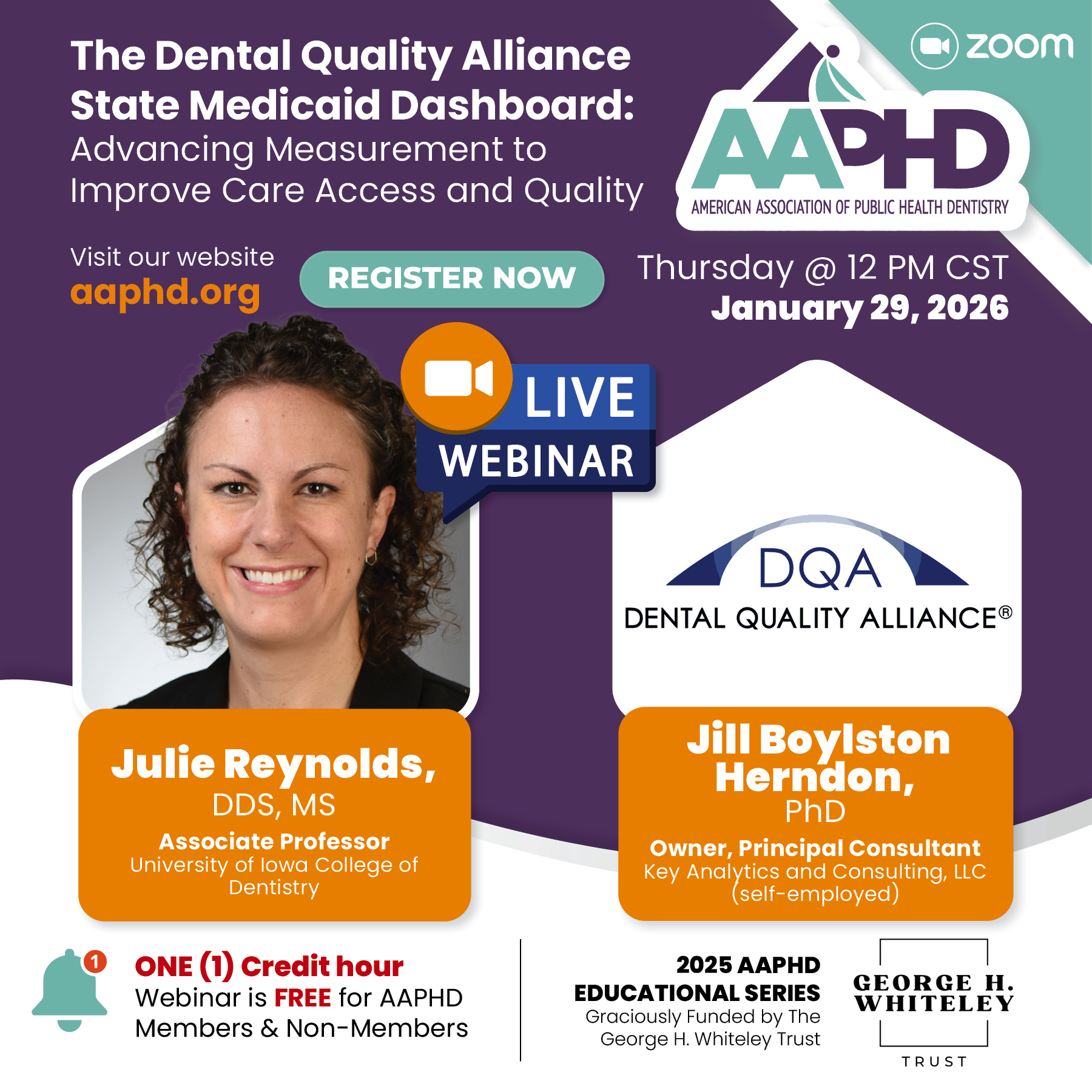 Register Today!Date: January 29
Time: 12-1pm CT
Topic: The Dental Quality Alliance State Medicaid Dashboard: Advancing Measurement to Improve Care Access and Quality
Who Should Attend: Anyone interested in quality measurement and improvement in dentistry, and/or dental care access and quality in state Medicaid programs.
Learning Objectives:
Featured Speakers:
Dr. Jill Boylston Herndon, PhD
Owner, Principal Consultant
Key Analytics and Consulting, LLC (self-employed)
Jill Herndon is an economist with extensive experience in research, policy analysis, program evaluation, project management, and education. She works with non-profit and for-profit organizations, government agencies, and academic institutions on measuring and evaluating healthcare delivery system performance with a focus on oral health care. She’s successfully secured grant funding from federal, state and private agencies; authored and co-authored more than 100 journal articles and technical reports; and delivered more than 100 presentations for a wide range of audiences. Dr. Herndon has served as the primary methodology consultant for the Dental Quality Alliance, guiding dental experts through the quality measure development process: concept design, measure testing, validation, implementation, and monitoring. She works routinely with large datasets of national Medicaid claims data, as well as a range of other datasets, to help dentists and the broader oral health community better understand the state of the U.S. dental care system.
Dr. Julie Reynolds, DDS, MS
Associate Professor
University of Iowa College of Dentistry
Julie Reynolds is President-Elect of AAPHD, immediate past Chair of the Dental Quality Alliance, a board-certified specialist in dental public health, and health services researcher. Her research focuses on aspects of dental care access and quality, including access and utilization for people with Medicaid as well as dental quality measurement and improvement in the context of a patient-centered dental home.
Official Statement from American Association of Public Health Dentistry (AAPHD)AAPHD opposes Department of Education’s Proposed Definition of “Professional Degree Programs"December 15, 2025 The American Association of Public Health Dentistry (AAPHD) strongly opposes the Department of Education’s preliminary proposal—developed during the recent RISE Committee Session 2—to exclude public health degrees from the federal definition of “professional degree programs” under the One Big Beautiful Bill Act (OBBBA). This exclusion is both alarming and unacceptable. For decades, the Master of Public Health (MPH), Doctor of Public Health (DrPH), and related public health–focused dental degrees have been recognized as essential professional credentials that prepare practitioners to protect, promote, and advance the health of communities. Public health dentistry is an integral part of the broader public health workforce, addressing disease prevention, oral health equity, and population-level interventions that directly impact overall health outcomes. At a time when the nation continues to face widening health disparities, rising oral disease burdens, and systemic challenges intensified by recent public health emergencies, excluding public health degrees from the professional degree category is short-sighted and detrimental to the nation’s health infrastructure. Public health— including public health dentistry—requires advanced professional training grounded in science, policy, management, and leadership. To ignore this reality is to overlook the very workforce responsible for safeguarding the health of populations. The implications of this proposal are profound. By jeopardizing students’ access to higher federal loan limits, the policy threatens to make public health education less attainable. Such barriers will narrow and weaken the pipeline of future public health dental leaders at a moment when the country urgently needs more skilled professionals trained to address complex oral health challenges and advance health equity in underserved communities. AAPHD urges the Department of Education to reconsider this proposal and include all public health degrees within the definition of “professional degree programs.” We also encourage our academic partners, members, and the wider public health community to actively participate in the forthcoming public comment period following the Notice of Proposed Rulemaking. We stand firmly with our colleagues across the public health disciplines in asserting that public health education is not optional—it is foundational to the nation’s health, resilience, and preparedness. AAPHD will continue to advocate vigorously for a definition that fully and accurately reflects the essential role of public health and dental public health within the broader healthcare system. Dental public health is a formally recognized specialty of dentistry, with educational programs accredited by the Commission on Dental Accreditation (CODA), an accrediting body recognized by the U.S. Department of Education. ***NOTE: A Notice of Proposed Rulemaking (NPRM) is expected soon. Once published, institutions will have 30 days to submit formal comments.
AAPHD Foundation Scholarships & Grant Applications Being Accepted through February 2!The AAPHD Foundation is the charitable arm of the AAPHD and provides monetary support for dental public health education and research. 2026 Small Grant Award The Small Grant program provides two separate grants. One grant is for up to $5,000 for projects which will be completed within a year and a second grant for up to $10,000 for projects which will be completed within 18 months of notification, that serve to generate data that can be used to apply for larger grants that can move science, policy, and practice to the “next step” toward enhancing oral health. Application & More Information 2026-2027 Herschel S. Horowitz Scholarship - Dentist $10,000 Scholarship to support dentists to pursue an MPH degree accredited by the CEPH or an advanced education program in dental public health accredited by CODA. Application & More Information 2026-2027 Herschel S. Horowitz Scholarship - Dental Hygienist $7,500 Scholarship to support hygienists to pursue an MPH or equivalent degree accredited by the CEPH or other unique educational opportunities in dental public health. It is expected payment will be made to the school to offset tuition expenses. Special Issue for JPHDTitle: Sexual and Gender Minority Oral Health: Advancing Equity and Inclusion Guest Editors: Fabio Leite and Tamanna Tiwari Call description: We invite the submission of original research, brief reports, methods papers, reviews, and perspectives that advance understanding of LGBTQIA+ (sexual and gender minority) oral health, with particular attention to population-level disparities and intersectionality. Manuscripts may address, but are not limited to: measurement and reporting of sexual orientation and gender identity in surveys and clinical records; patient-experience outcomes (including dignity and discrimination); innovations in education and training; community-engaged and participatory research; health services and delivery models (coverage, benefits, teledentistry, workforce development); implementation science and quality improvement; ethical considerations and inclusive terminology; and global perspectives, including those from low- and middle-income countries (LMICs). Abstract submission: Add a title and author names and affiliations. Abstract should be 250 words consisting of four paragraphs, labeled Objectives, Methods, Results, and Conclusions. These sections should describe the problem being addressed in the study, how the study was performed, the salient results (without statistical tests), and what the authors conclude from the results. Submit the abstract to JPHD Abstract Submission Send your queries to: [email protected]; [email protected]
|

© American Association of Public Health Dentistry 
136 Everett Road
Albany, NY 12205
Phone: (518) 694-5525
E-mail: [email protected]
Privacy Policy and Terms
Back to top